
Follow the South West Coast Path between Bideford and Appledore and you are walking in the footsteps of the workers making their way to and from work in shipyards. This section of the coast path is known locally as the ‘shipyard path’.
More about the South West Coast Path between Bideford and Appledore
The South West Coast Path between Appledore and Bideford is well signed and generally in good condition, although some sections can be muddy and slippery, especially after heavy rain. Only the sections along the quays in Appledore and Bideford are wheelchair accessible. The route takes between 1 ½ to 2 hours in one direction. There are buses between Appledore to Bideford if you don’t want to walk both ways.
In summer, at high tide only, the Appledore / Instow ferry takes passengers across the river and makes possible a circular walk along the Tarka Trail.
Take great care if walking on the foreshore. Mud on the estuary foreshore can be deep and sticky and is always black. The tides move quickly and create strong currents.
Shipbuilding on the Torridge spans over 500 years. Read more here:
Shipbuilding along the Torridge spans over 500 years. Henry VIII’s official antiquary, John Leland, visited North Devon in 1542. He wrote “From this ness (where Taw and Torridge meet) up to Bedeford Bridge upon Turege, wher is a praty quik (very lively) streat of smithes and other occupiers for ship crafte cis pontem (beside the bridge)”
Describing the history of ship yards along the Torridge gets complex. Shipbuilders moved site as their business grew or contracted and as different sites became available. So, the names of several shipbuilder families crop up at different sites at different times. Rather than describe the history of the families we have concentrated on history of the sites.
Naming of sites is by the current owner’s name or name on current maps but many sites have several names used at different times which can add another layer of confusion.
Building wooden ships needed a shipwright, some skilled tradesmen and a suitable beach with space to dig a saw pit for cutting timber. Building iron and steam ships required more capital investment in docks, materials and engineering skills.
North Devon Maritime Museum, Appledore has exhibitions on shipbuilding and all things maritime. NDMM information and opening times.
Click on the links below to find out more about the history of these ship building sites and ships launched:

Some of the historic sites have very little visible of their shipbuilding history today. The records of ships built, newspaper articles of launches and photographs or paintings of vessels provide a vivid record of this important industry.
Watertown J Hinks and Son
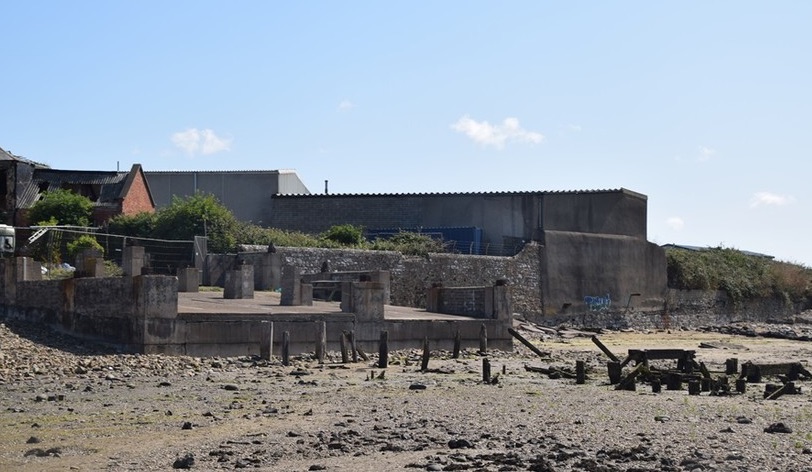
In 1967, Alan Hinks moved the business from a site on Irsha Street, Appledore to a covered yard in Watertown, building wooden launches and fishing boats.
They became nationally and internationally known for building the replicas of the 17th century Hudson Bay two masted ketch Nonsuch in 1968 followed three years later by a full-size reconstruction of Sir Francis Drake’s Elizabethan galleon The Golden Hinde, the first English ship to circumnavigate the globe, currently open to the public in Southwark, London.
Today the site is a garage business. The boat slip and boat ramps into the estuary are still in place, although starting to decay.
Irsha Street Appledore
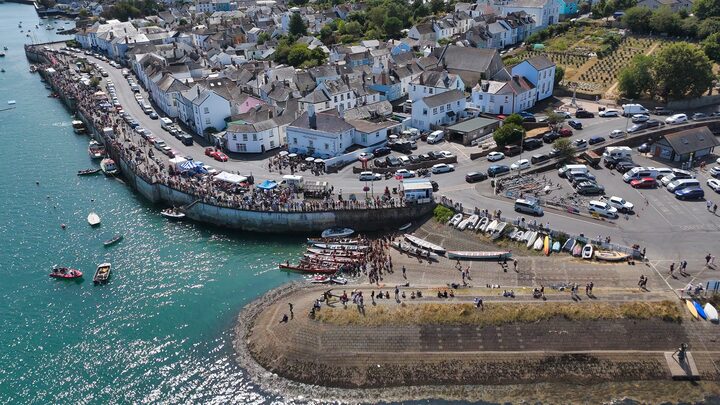
There were several boatyards running down to the river off Irsha Street. Today none of these Irsha Street yards are active and the sites only traceable from street names.
The Cock family ran the Tavern Yard at the west end of Appledore Quay by the Seagate (formerly Grand Hotel) from around 1850. There was a patent slip – a wheeled ‘cradle’ that slides into the water to float a vessel on, and winching mechanisms that haul the ship ashore for dry-dock repairs. In 1882 the Cock family purchased Richmond Dock at the east end of the quay.
In the early 20th century Irsha Street yards constructed many lifeboats for the steam ships of Sir William Reardon Smith. A native of Appledore he went to sea at age 12 and worked his way up becoming a master mariner. Eventually he settled in Cardiff and established one of the most prominent shipping fleets in the UK. He ordered lifeboats for his new vessels from Appledore boat builders. They were rowed up river to the railway goods yard at East the Water from where they were sent by train to the shipyard building his latest steam ship. All his new vessels were registered in Bideford, despite the fact that most of them would have been too large to enter the estuary.
The Ibex Yard was run by Philip Waters and Sons, constructing launches and specialising in ships boats. In a testimonial written in 1942 the master of the Reardon Smith liner Quebec City, sunk by a U Boat, thanked the builders of the lifeboat that ‘stood up to the most gruelling test sailing 750 miles in 12 days’.
John Hinks and Son specialised in open boats for salmon fishing before moving to Watertown in 1967
Richmond Dock Appledore
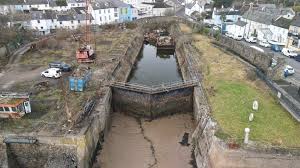
Constructed in 1856 by William Yeo this Grade II listed dock is the most complete and original piece of maritime architecture on the estuary and significant for the maritime history of South West England.
Richmond Dock made Appledore the centre of William Yeo’s business empire which was based around expansion of North American trade. It is huge in the context of its time. Three hundred and thirty feet long, it could take four of Yeo’s smallest ships at once. To construct it, the waterfront of Appledore was dramatically changed with the head of the dry dock cut into the head of the old inlet. New access roads to the foreshore were constructed and there were associated buildings including a foundry, blacksmith, blockmaking shops, sail lofts and mast houses.
Purchased by Robert Cock in 1882 the dock was converted to build steel ships.
In 1932, taken over by P K Harris and Sons, it reverted back to constructing and repairing wooden vessels.
P K Harris had been building and repairing wooden vessels in the New Quay yards just south of Richmond Dock. Under P K Harris emphasis shifted from building to repair, but during World War II there was an urgent requirement for wooden minesweepers & motor torpedo boats and the yard produced 29 vessels between 1940 – 1945.

Admiral Franklin with Fred Harris on deck of Motor Torpedo Boat (MTB) November 1942.
P K Harris secured orders for the Navy’s ‘maids of all work’ somewhat confusingly known as Motor Fishing Vessels (MFV) as well as Motor Minesweepers (MMS), Motor Gun Boats (MGB), Motor Torpedo Boats (MTB), and Motor Launches (ML). These latter often deployed as Harbour Defence Launches (HDML) or Seaward Defence Motor Launches.
The yard changed name to Appledore Shipbuilders in 1963 and continued building vessels until it closed following construction of the covered shipyard at Bidna, which opened in 1970 – now Navantia Appledore. The last construction project at Richmond Dock was components for the new A39 Torridge Bridge which opened in 1987.
In 2025, after purchasing Richmond Dock, the Wheatcroft Collection submitted plans to renovate the site and house maritime items from the Wheatcroft Collection, including one of the last surviving German E Boats (similar to a Motor Torpedo Boat).
More details of some vessels launched from Richmond Dock
Harris and Sons WW II Vessels : 32 vessels ordered; 3 orders cancelled. 29 vessels completed Jan 1940 – Sep 1945: 8 x 72ft ML Motor Launch Fairmile B; 5 x 105ft MMS Motor Mine Sweeper; 9 x 120ft MTB Motor Gun Boat Fairmile D; 2 x126ft MMS II Motor Minesweeper; 6 x75ft MFV Motor Fishing Vessel 601; 2 x 45ft MFV Motor Fishing Vessel 601.
Appledore Maritime Innovation Centre

The new Appledore Maritime Innovation Centre is due to open in 2026. It will support innovation in clean propulsion, maritime cyber security, aquaculture, unmanned vessels and environmental intelligence.
This seems likely to have been the site of Appledore’s first quay built around 1672 when the town briefly became the point of tax collection for Appledore, Bideford and Barnstaple. The site was purchased by Appledore landholder and ship-owner, John Benson about 1737. Some 10 years later his son, Thomas, built a new stone quay, 200 feet long and creating ‘New Quay’ – the most substantial of several quays owned by the Benson family. Thomas Benson is one of North Devon’s most colourful characters and you can read more about Thomas Benson here. A large warehouse was constructed along the western boundary and this area became known as Middle Dock after 1891, when the Cock family owned both it and Richmond Dock to the north. Between 1891 and 1916 Middle Dock was used for building small iron barges, so acquiring the name “Iron Yard”. During World War II, when owned by P K Harris, it was used in the construction of high-speed wooden military motor launches.
The Appledore Maritime Innovation Centre will provide workshops and office spaces and with its 80m quay and slipway businesses will be able to test engineering ideas directly in the Taw-Torridge Estuary. Partly funded by £15.6m from the Levelling Up Fund the new centre is due to open in 2026.
More details of some vessels launched from Middle Dock are included in Richmond Dock under Robert and James Cock and P K Harris WW II launches.
New Quay
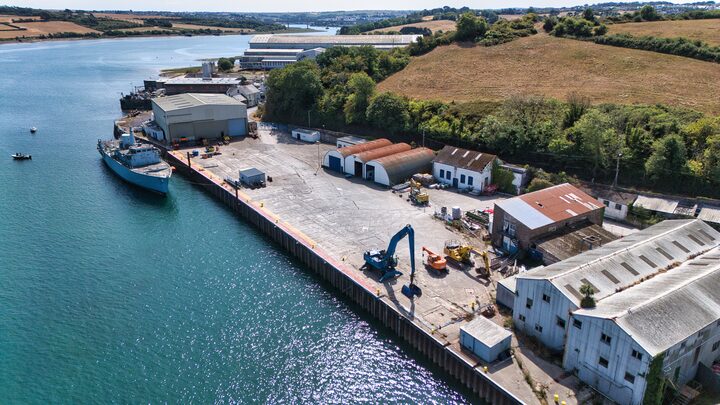
By 1830 Thomas Benson’s New Quay had been considerably lengthened, and in addition to import / export there was a shipyard established. Between 1855 – 1889 the site underwent considerable changes. The estuary edge was extended outwards and straightened and a dry dock created.
Zoom in on the aerial photograph from 1950 which shows the site with dry dock and before the covered shipyard at Bidna Marsh was built. Historic England – The estuary of Rivers Taw and Torridge and Appledore from South East 1950.
Today it forms part of the Navantia Appledore site and is used for fitting out vessels.
Since 2024, in partnership with Torridge District Council, it has been used to berth and discharge 3000 ton cargo ships with animal feed destined for Devon farms. The feed is very dusty and so not ideal to be discharged in Bideford. Each ship takes up to 100 lorries off the road network.
More details of some vessels launched from New Quay
In addition vessels launched by Robert Cock and P K Harris are listed under Richmond Dock

The shipyard built on Bidna Marsh opened in 1970. Planned and built with factory style work flows for efficient production it was described as the ‘first ship factory in Europe’ and at the time was the largest covered shipyard in Europe.
The history of the shipyard reflects the economic ups and downs of the national shipbuilding industry. It developed from the company of P K Harris and Sons, based at Richmond Dock in the early 20th century, changing name to Appledore Shipbuilders in 1963.
In 1964 it was acquired by the airlines and shipping group Court Line, who built the factory on the Bidna Marsh greenfield site. The company was nationalised in 1974 when Court Line collapsed. Appledore Shipyard itself went into receivership in 2003 and was rescued by becoming part of DML, who ran Devonport Dockyard, Plymouth. At this time the yard’s main activity was the installation of machinery packages and other systems for luxury yachts.
The site was renamed Babcock Marine Appledore in 2007 (after the acquisition of DML by Babcock International). With a Royal Navy contract to construct bow sections, flight deck sponsons and centre blocks for the flight deck for the two Queen Elisabeth class aircraft carriers 300 jobs were secured in Appledore until 2015. In 2018 Babcock announced that it had no future for the shipyard and it closed in March 2019. The last vessel to be built was the LÉ George Bernard Shaw (P64) an offshore patrol vessel for the Irish Navy.
One year later, in 2020, it was renamed H&W Appledore when InfraStrata (owners of Harland & Wolff in Belfast) bought the dormant yard for £7 million. The Harland & Wolff company then collapsed in 2024.
In 2025, Navantia SA, Spanish state-owned shipbuilding company with a shipbuilding tradition of 300 years, acquired Harland & Wolff creating Navantia UK. The site was renamed Navantia Appledore. It is now manufacturing the bow sections for three RFA (Royal Fleet Auxiliary) vessels. Work on the first, RFA Resurgent, commenced at a steel cutting ceremony in 2026. After assembly in Appledore, these massive bow blocks will be loaded onto the transport barge, Seahorse, and shipped to Harland & Wolff in Belfast, alongside modules from Spain, for final integration. Backed by significant investment, the site has been upgraded with state-of-the-art plasma cutters and modern steel-fabrication technology and currently (2026) employs over 200 including 30 apprentices.
Since 1970 the yard has built more than 350 vessels, including small and medium-sized military craft, bulk carriers, LPG carriers, super yachts, ferries, and oil-industry support vessels. More details of some vessels launched from Appledore Bidna Yard.
Pictures of some vessels launched from Appledore Bidna Yard

Boathyde

The foreshore at Boathyde has been used for ship building and ship breaking.The house here probably has a non-domestic origin, perhaps a warehouse or shipyard structure next to the lime kiln and landing place (hythe).
1803-1804: launch brigantine Industry (1804) and Ann (1804) – builder unknown
1928-1933: M V Blackmore moved here from Irsha Street before moving to Ford Yard
List and more details of vessels launched from Boathyde unavailable – launch records not found
Lower Cleave

In 1813 Richard Chapman owned a lime kiln, house and property and may have done some building here.
Between 1783 and 1804 Edward Jenkins launched 8 vessels including the brigantine Union (1783) and a South Seas whaler Aurora (1801)
In 1805 William Frost, recently apprenticed at HM Dockyard Plymouth, advertised a sloop of 50 tons would soon be launched. This was sold as the Bucks and although only two other vessels can be attributed to him it is likely he was building there for some time.
Between 1891 and 1908 John Westacott from Barnstaple opened a yard on the north side, close to a small private dock. He had taken a lease at New Quay, went bankrupt in 1891 and managed to find finance to set up again. He launched Marion 79 tons that year and built yachts and pilot cutters alongside his ship repair business.
The yard closed in 1908 but had a brief revival between 1942-1945 when Boon Brothers (usually house and shop builders) constructed a number of naval harbour launches. Sydney Boon had been apprenticed to John Westacott.
Today the name Limers Lane recalls the previous industrial activity here and the foreshore can easily be imagined as a suitable place for shipbuilding and repair.
Bank End
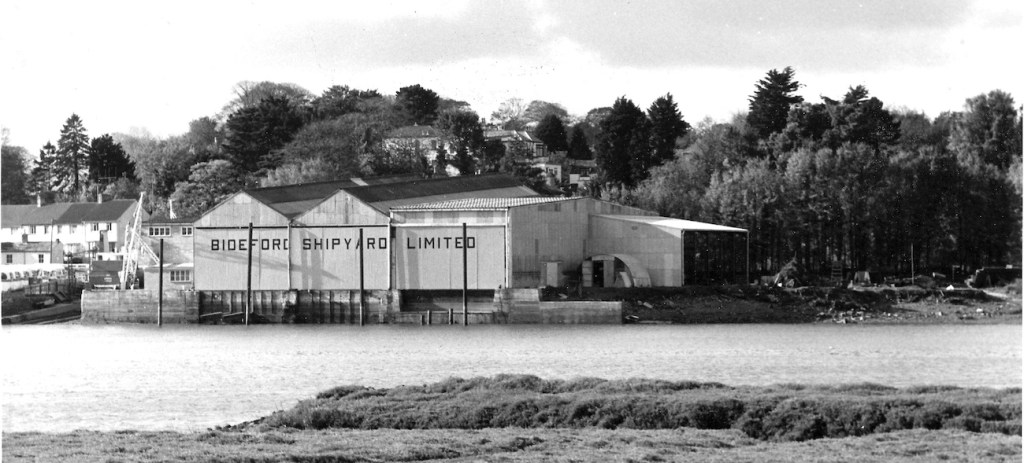
The South West Coast Path passes Torridge District Council offices and the houses of Riverside Court and along the seawall. There is now virtually nothing to see of this once extensive shipbuilding site.
Between 1805 and 1814 Richard Chapman built seven ships for the Royal Navy, four of ‘sixth-rate’, the first being the 118 foot Garland (of the Laurel or Henslow Class), carrying twenty-two 9-pound guns on the upper deck. However, captains often carried more guns than the official rating. The Garland carried six 24-pounders on her quarter deck, two more on her forecastle and two 16-pound, long barrelled ‘chasers’. Garland‘s full crew was 155 officers and men. She was ordered in 1805, her keel laid in 1806, and launched on 2 October 1807. Unfortunately, like other ships surplus to requirement after the Napoleonic wars, she was broken up in 1818. Richard Chapman also built ships of the Rosamond Class – copies of a French design. After the outbreak of the Napoleonic wars, it became apparent that French ships were better designed and faster than those of the British Navy. Consequently, a captured French ship was not only much appreciated – it was often physically measured and copied.
The Cleave Shipbuilding Yard (also known as the Cleave Houses Shipyard) was established by George Cox in mid 19th century building large wooden sailing vessels, including military vessels for the Royal Navy. Sarah Neumann was built in 1855 and there were ‘great celebrations’ when this full-rigged ship was launched. George Cox’s son John continued the business


Nineteenth-century shipbuilding here came to an end in 1892 when H.M. Restarick, who moved here from East the Water in 1888, closed his yard.
In 1920, Sven Wohlford Hansen, a Norwegian shipbuilder, took out a lease on the site. Hansen had shipping and coal interests in South Wales and Hansen Shipbuilding and Repairing Company was established in 1919. The yard built ten coasters – 5 for Stone and Rolff of Llanelly, 4 for Spillers and Bakers, Cardiff and 1 for John Hughes, Liverpool. The enterprise collapsed in 1924, as a result of the economic downturn in both colliery and shipping activity.
After 1945 a workshop specialising in developing light alloy aluminium launches was active and produced some 600 craft, 95% of which were exported to tropical countries where aluminium was better suited for maritime use than wood. The firm eventually moved to the River Hamble and became Universal Shipyards (Solent) Ltd.
For a few years the yard was leased to Blackmores until in 1963 it was sold to Wykeham-Supramar Hydrofoil – experimenting and testing hydrofoil design.
There was insufficient work on hydrofoil design to keep the work force occupied and so Bideford Shipyard Ltd was formed, building a wide range of steel craft. The business prospered and additional slips and covered ways were built. Output was fishing craft, mooring service vessels, passenger and specialist vessels including Tri-Star for Padstow, City of Bristol for RNLI and Grima ferry for Shetland.
Financial problems threatened closure in 1973 and the hundred strong workforce volunteered to work without pay whilst a buyer was found. Bideford Shipyard (1973) was created but the yard finally closed in 1979.
More details of some vessels launched from Bank End


Ropewalk / Potters Pill
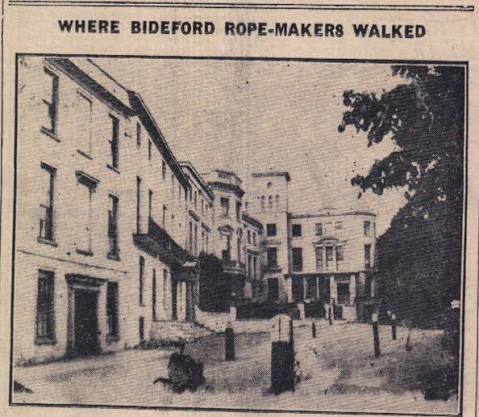
Potters Pill got its name from the potteries operating in the streets above this pill (the local name for a tidal creek). The pill was used by ships unloading clay and taking away finished pottery for export.
Along the bank of the pill was a ropewalk with posts as in the picture.
From 1799 George Crocker built sloops, brigs and cargo vessels here. He also built one warship Acorn (1807) with 18 guns, but at that size it may have been too big for the Pill. The yard closed in 1840 when the land was redeveloped.
The south bank of the pill was the site of a ropeworks – hence the street name Ropewalk. This was operated for many years by the Wren family before being acquired by H M Restarick. The ropewalk closed in in 1897 and the long building along Ropewalk is a collar factory (Grade II listed). It closed in the 1920s when detachable collars were no longer in demand.
The pill was finally completely filled in at the end of the 19th century with the construction of the Bideford to Appledore railway (1901 to 1916) over what is today Pill Car park and Kingsley Road near the Bideford Arts Centre (Learn Devon) and Library.
More details of some vessels launched by George Crocker
East the Water

By 1542 shipbuilding was already well established at East the Water. At different times the East the Water shore was the site of at least six yards with smaller boat building yards upstream of the bridge.
The picture shows ships being built at Restarick’s yard next to the bridge in 1883.
William Taylor built a number of commercial and naval vessels at Cross Park including Rocket (1824) for the Newfoundland and Mediterranean trade, Saltren’s Rock (1827) and for the Navy the Thai Class fireship Comet (1807) and Vesuvius Class bomb vessel Beelzebub (1813). The 20 gun Sixth Rate Sloop Falmouth(built 1814) was later used to land a garrison on Tristan da Cunah.
In 1825 Henry Tucker launched the Lady Clinton – a painting shows her in full sail off Naples. He later moved out of shipbuilding to focus on malting and bark export (used in the leather tanning industry).
In 1845 Thomas Waters established a shipyard near Crosspark Rock (a feature that is now hidden beneath Ethelwynne Brown Close). He was joined by his son William who went on to build ships near the Sea Lock of the Rolle Canal upstream of Bideford Bridge. In 1856 the yard celebrated the launch of two ships for local owners (Heroine and Gleanings) with a feast for workers in Mr Hammett’s sail loft, supplied by the Terminus Inn. The yard eventually closed in 1871 when they were given 10 days notice to give up the yard due to the extension of the railway line to Torrington.
Thomas Brook lived at No. 1 Barnstaple Street and owned a shipyard adjoining Thomas Waters. By 1947 the site of his yard was occupied by the Western Counties Association Ltd.
Next to Bideford Long Bridge on the site today called Brunswick Wharf, a name it acquired only after the end of shipbuilding here, were a number of unidentified builders followed by two generations of the Johnson family (1839-1876) and then Henry Morgan Restarick, the last shipbuilder at East the Water.
Robert Johnson started his business around 1839 and after his death his wife Ann took an active role, even signing some building certificates. Their son John took over in 1858 and continued shipbuilding until 1877. With nearly 40 years of shipbuilding their output was prolific with at least 78 vessels attributed to them. They typically produced ships of between 100 and 430 tons, including a number of vessels for Brixham and Dartmouth owners in the Newfoundland trade, for Plymouth and Bideford owners in the Mediterranean trade, and for Salcombe owners in the soft fruit trade. Examples include the 1851 schooner Vivid and the 1855 brig Prothesa. One of their most unusual launches was the Lady Gertrude, rebuilt from the Austria Hungarian barque Pace, that had been wrecked on Westward Ho! beach in 1869.
Henry Morgan Restarick, originally from Axminster, was the last shipbuilder at East the Water. Under his management the yard produced around 25 fishing smacks for the growing North Sea fishing industry. This number included 3 vessels of the same design for the Mission for Deep Sea Fishermen, used as dispensaries sailing with the North Sea fishing fleet. At least two of these went on the be requisitioned by the Admiralty in WW I and used for mine hunting and anti-submarine actions. Restarick moved to Bank End after the closure of the East the Water yard in 1886.
Kathleen and May, the Bideford registered coastal trading schooner originally built in North Wales in 1900, was restored on Brunswick Wharf between 1998 and 2001. She was moored here, attracting many visitors, until 2010 when she moved to Liverpool. She is currently (2026) moored in Gloucester.
George Edward Parkin started building boats in Bideford in about 1847 and operated from a yard opposite the Blacksmith’s Arms (later it became an elementary school) until he moved to Appledore ten years later. His advertisements claim the use of steam bent timber made his carvel boats lighter and stronger. By 1852 his pilot boat True Blue, a vessel that won competitions in local regattas, had significantly boosted the yard’s reputation. But Parkin also has a more precious claim to fame. In July 1852, when he saw a seven-year-old local lad in danger of being swept away, he leapt from the rear wall of his house and rescued him. Just over ten years later, after Parkin leapt to the rescue of another lad, this time in Appledore, the press reported this was the twenty sixth individual that Parkin had plucked from a potential watery grave. And this wasn’t Parkin’s final rescue, for in 1871, after his twenty-ninth rescue, he was recognised by the Royal Humane Society
Today all the shipyard sites have all been covered by more recent developments. When the last yard closed in 1886 Baker’s Builders Merchants built the quay wall and named Brunswick Wharf. The site is now being redeveloped as a mix of housing and commercial units. The archaeological report carried out for the development is here.
More details of some vessels launched from East the Water yards:
‘A history of East the Water, Bideford’ describes the long history of the wharves and their commercial importance to the local area. After introducing East-the-Water and the wharves, the book examines the important strands that make up the history of the local community: timber, emigration, shipbuilding, tobacco and pottery, coal mining and gravel extraction, fisheries, agriculture, energy and enterprise as well as the changes brought about by steamships and railways. It is available from The Burton at Bideford and Walter Henry’s bookshop.
East the Water Vessels


Ford Yard Blackmore & Sons

Blackmore’s moved here from Boathyde in 1933. The yard had an extensive covered workshop and was equipped for building in wood. It specialised in yachts, passenger vessels, pilot boats, fishing boats.
The drawing by V C Boyle shows work on Black Prince.
Blackmore’s specialised in yachts, passenger vessels, pilot boats, fishing boats. The first vessel built here was a twin-screw cabin cruiser, followed soon afterwards by the pilot vessel Marian Byass, 57 tons, for Port Talbot. In 1933 the motor launch Dido of London was built, she is now being restored at Exeter.
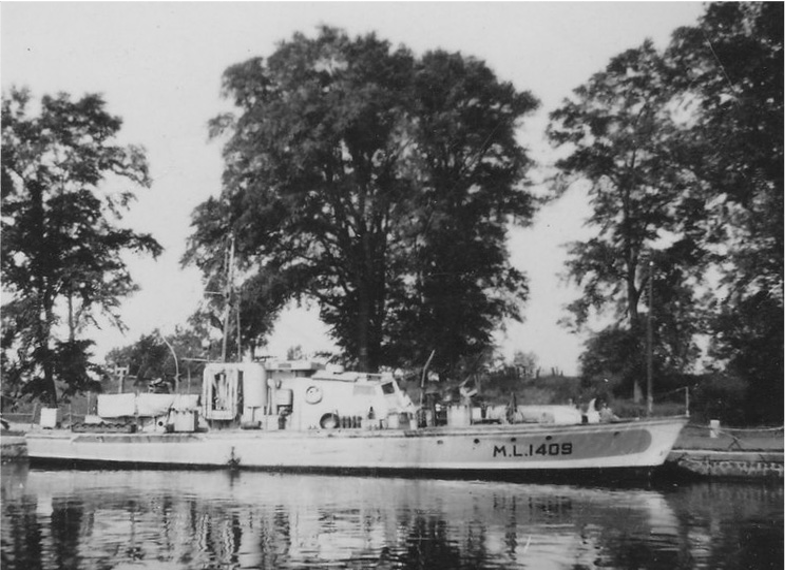
During WWII the yard built 28 x 72ft Harbour Defence Motor Launch (HDML) and 10 x 45ft Motor Fishing Vessel (MFV). Some of the MFVs still at the yard when hostilities ceased were completed as fishing vessels for civilian owners.
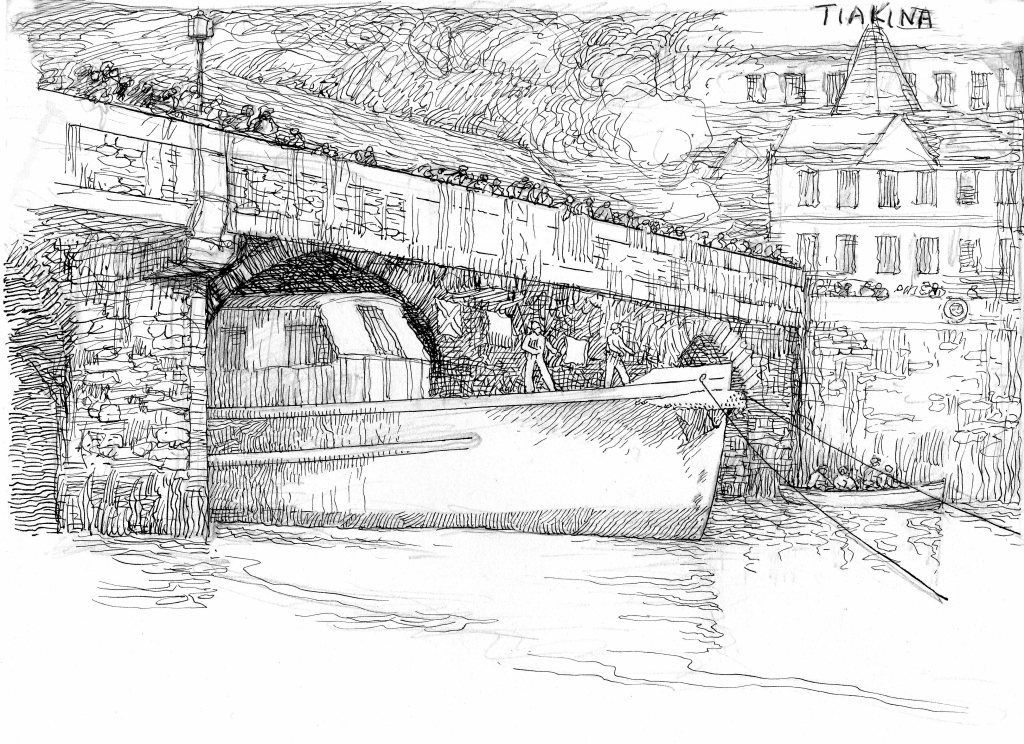
In 1947 Blackmore’s largest vessel to date was the 91 tons passenger vessel Torbay Prince. There were also the pilot vessel Tiakina, 81 tons, for New Zealand (1953), and four motor mine-hunters for the Navy (1953-5). Later craft were the sister vessels Humphrey Gilbert and Adrian Gilbert, 35 tons, for the Kingswear-Dartmouth ferry; two pilot vessels Nathla and Nuzha, 74 tons, for Qatar; and ten or more shark-fishing boats for a Development Corporation scheme in West Africa. Yachts were built in large numbers, some of standard designs such as the ‘Pilot’ (6 tons Thames Measurement), and others to special design, including Ishudkoko, (1962) for a famous band-leader owner. During 1956-63 Blackmore used the shipyard at Bank End for repairs and fitting out their larger craft and moved there for a short time before closing. This means vessels had to be taken under Bideford Long Bridge for fitting out before all structure was in place. Drawing by V C Boyd shows this for Tiakina in 1953.
Economic conditions led to the closure of the yard in 1964, the last launch being a work-boat for river conservancy, the Medway Leader, 42 tons. The yard has been demolished.
More details of some vessels launched by Blackmore
M W Blackmore and Son Bideford
Blackmore & Son WW II Vessels: 38 vessels ordered; 3 orders cancelled. 35 vessels completed between Jan 1940 – Nov 1945: 28 x 72ft ML Harbour Defence Motor Launch; 10 x 45ft MFV Motor Fishing Vessel
Note many smaller craft would not be registered.
—————————
This shipyard trail has been produced in partnership between Bideford & River Torridge Heritage Harbour, North Devon Maritime Museum, MOLA Coasts in Mind and Navantia Appledore
Images courtesy of North Devon Maritime Museum unless stated otherwise
Lady Gertrude 1888 – Aberdeen Museums and Galleries, Prothesa 1855 – Salcombe Maritime Museum, HDML 1409 from https://www.hmsmedusa.org.uk/hdml-1409/, Aerial Photos – Skyrelics
The trail will be launched on 19 September 2026 as part of Heritage Open Days

